Category: Uncategorized

  • Small study suggests 40Hz sensory stimulation may benefit some Alzheimer’s patients for years

    Small study suggests 40Hz sensory stimulation may benefit some Alzheimer’s patients for years

    Five volunteers continued receiving 40Hz stimulation for around two years after an early-stage MIT clinical study. Those who had late-onset Alzheimer’s performed significantly better on several assessments than comparable Alzheimer’s patients outside the trial

    A new research paper documents the outcomes of five volunteers who continued to receive 40Hz light and sound stimulation for around two years after participating in an MIT early-stage clinical study of the potential Alzheimer’s disease therapy. The results show that for the three participants with late-onset Alzheimer’s disease, several measures of cognition remained significantly higher than comparable Alzheimer’s patients in national databases. Moreover, in the two late-onset volunteers who donated plasma samples, levels of Alzheimer’s biomarker tau proteins were significantly decreased.

    The three volunteers who experienced these benefits were all female. The two other participants, each of whom were males with early-onset forms of the disease, did not exhibit significant benefits after two years. The dataset, while small, represents the longest-term test so far of the safe, non-invasive treatment method (called GENUS, for gamma entrainment using sensory stimuli), which is also being evaluated in a nationwide clinical trial run by MIT-spinoff company Cognito Therapeutics.

    “This pilot study assessed the long-term effects of daily 40Hz multimodal GENUS in patients with mild AD,” the authors wrote in Alzheimer’s & Demetntia: The Journal of the Alzheimer’s Association. “We found that daily 40Hz audiovisual stimulation over 2 years is safe, feasible, and may slow cognitive decline and biomarker progression, especially in late-onset AD patients.”

    Diane Chan, a former research scientist in The Picower Institute for Learning and Memory and a neurologist at Massachusetts General Hospital, is the study’s lead and co-corresponding author. Picower Professor Li-Huei Tsai, director of The Picower Institute and the Aging Brain Initiative at MIT, is the study’s senior and co-corresponding author.

    An “open label” extension

    In 2020, MIT enrolled 15 volunteers with mild Alzheimer’s disease in an early-stage trial to evaluate whether an hour a day of 40Hz light and sound stimulation, delivered via an LED panel and speaker in their homes, could deliver clinically meaningful benefits. Several studies in mice had shown that the sensory stimulation increases the power and synchrony of 40Hz gamma frequency brain waves, preserves neurons and their network connections, reduces Alzheimer’s proteins such as amyloid and tau, and sustains learning and memory. Several independent groups have also made similar findings over the years.

    MIT’s trial, though cut short by the Covid-19 pandemic, found significant benefits after three months. The new study examines outcomes among five volunteers who continued to use their stimulation devices on an “open label” basis for two years. These volunteers came back to MIT for a series of tests 30 months after their initial enrollment. Because four participants started the original trial as controls (meaning they initially did not receive 40Hz stimulation), their open label usage was six to 9 months shorter than the 30-month period.

    The testing at 0, 3 and 30 months of enrollment included measurements of their brain wave response to the stimulation, MRI scans of brain volume, measures of sleep quality and a series of five standard cognitive and behavioral tests. Two participants gave blood samples. For comparison to untreated controls, the researchers combed through three national databases of Alzheimer’s patients, matching thousands of them on criteria such as age, gender, initial cognitive scores, and retests at similar timepoints across a 30-month span.

    Outcomes and outlook

    The three female late-onset Alzheimer’s volunteers showed improvement or slower decline on most of the cognitive tests, including significantly positive differences compared to controls on three of them. These volunteers also showed increased brain-wave responsiveness to the stimulation at 30 months and showed improvement in measures of circadian rhythms. In the two late-onset volunteers who gave blood samples, there were significant declines in phosphorylated tau (47 percent for one and 19.4 percent for the other) on a test recently approved by the FDA as the first plasma biomarker for diagnosing Alzheimer’s.

    “One of the most compelling findings from this study was the significant reduction of plasma pTau217, a biomarker strongly correlated with AD pathology, in the two late-onset patients in whom follow-up blood samples were available,” the authors wrote in the journal. “These results suggest that GENUS could have direct biological impacts on Alzheimer’s pathology, warranting further mechanistic exploration in larger randomized trials.”

    Though the initial trial results showed preservation of brain volume at 3 months among those who received 40Hz stimulation, that was not significant at the 30-month timepoint. And the two male early-onset volunteers did not show significant improvements on cognitive test scores. Notably, the early onset patients showed significantly reduced brain-wave responsiveness to the stimulation.

    Though the sample is small, the authors hypothesize that the difference between the two sets of patients is likely attributable to the difference in disease onset rather than the difference in gender.

    “GENUS may be less effective in early onset Alzheimer’s disease patients, potentially owing to broad pathological differences from late-onset Alzheimer’s disease that could contribute to differential responses,” the authors wrote. “Future research should explore predictors of treatment response, such as genetic and pathological markers.”

    Currently, the research team is studying whether GENUS may have a preventative effect when applied before disease onset. The new trial is recruiting participants aged 55+ with normal memory who have or had a close family member with Alzheimer’s disease, including early-onset.

    In addition to Chan and Tsai, the paper’s other authors are Gabrielle de Weck, Brennan L. Jackson,, Ho-Jun Suk, Noah P. Milman, Erin Kitchener, Vanesa S. Fernandez Avalos, MJ Quay, Kenji Aoki, Erika Ruiz, Andrew Becker, Monica Zheng, Remi Philips, Rosalind Firenze, Ute Geigenmüller, Bruno Hammerschlag, Steven Arnold, Pia Kivisäkk, Michael Brickhouse, Alexandra Touroutoglou, Emery N. Brown, Edward S. Boyden, Bradford C. Dickerson and, Elizabeth B. Klerman.

    Funding for the research came from the Freedom Together Foundation, the Robert A. and Renee E. Belfer Family Foundation, the Eleanor Schwartz Charitable Foundation, the Dolby Family, Che King Leo, Amy Wong and Calvin Chin, Kathleen and Miguel Octavio, the Degroof-VM Foundation, the Halis Family Foundation, Chijen Lee, Eduardo Eurnekian, Larry and Debora Hilibrand, Gary Hua and Li Chen, Ko Han Family, Lester Gimpelson, David B Emmes, Joseph P. DiSabato and Nancy E. Sakamoto, Donald A. and Glenda G. Mattes, the Carol and Gene Ludwig Family Foundation, Alex Hu and Anne Gao, Elizabeth K. and Russell L. Siegelman, the Marc Haas Foundation, Dave and Mary Wargo, James D. Cook, and the Nobert H. Hardner Foundation.

    description
  • MIT invents human brain model with six major cell types to enable personalized disease research, drug discovery

    MIT invents human brain model with six major cell types to enable personalized disease research, drug discovery

    Cultured from induced pluripotent stem cells, ‘miBrains’ integrate all major brain cell types and model brain structures, cellular interactions, activity, and pathological features.

    A new 3D human brain tissue platform developed by MIT researchers is the first to integrate all major brain cell types, including neurons, glial cells and the vasculature into a single culture. Grown from individual donors’ induced pluripotent stem cells, these models—dubbed Multicellular Integrated Brains (miBrains)—replicate key features and functions of human brain tissue, are readily customizable through gene editing, and can be produced in quantities that support large-scale research. 

    Although each unit is smaller than a dime, miBrains may be worth a great deal to researchers and drug developers who need more complex living lab models to better understand brain biology and treat diseases. 

    “The miBrain is the only in vitro system that contains all six major cell types that are present in the human brain,” said Li-Huei Tsai, Picower Professor, director of The Picower Institute for Learning and Memory, and senior author of the study describing miBrains, published Oct. 17 in the Proceedings of the National Academy of Sciences.

    “In their first application, miBrains enabled us to discover how one of the most common genetic markers for Alzheimer’s disease alters cells’ interactions to produce pathology,” she added.

    Tsai’s co-senior authors are Robert Langer, David H. Koch (1962) Institute Professor, and Joel Blanchard, associate professor in the Icahn School of Medicine at Mt. Sinai in New York and a former Tsai Laboratory postdoc. The study is led by Alice Stanton, former postdoc in the Langer and Tsai labs and now assistant professor at Harvard Medical School and Massachusetts General Hospital, and Adele Bubnys, a former Tsai lab postdoc and current senior scientist at Arbor Biotechnologies.

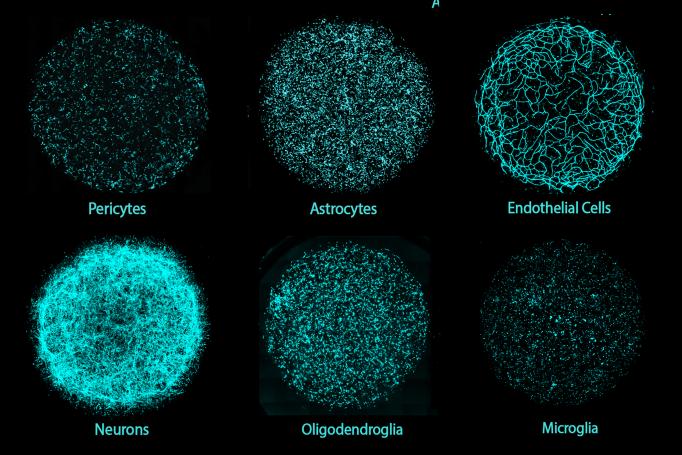
    Six panels show a cyan-stained tangle of cells in a round shape. From left to right then top to bottom the cell labels are pericytes, astroocytes, endothelial cells, neurons, oligodendrocytes, microglia

    Cyan staining shows each of the six major cell types integrated in a miBrain culture.

    Benefits from two kinds of models 

    The more closely a model recapitulates the brain’s complexity, the better suited it is for extrapolating how human biology works and how potential therapies may affect patients. In the brain, neurons interact with each other and with various helper cells, all of which are arranged in a three-dimensional tissue environment that includes blood vessels and other components. All of these interactions are necessary for health and any of them can contribute to disease. 

    Simple cultures of just one or a few cell types can be created in quantity relatively easily and quickly, but they cannot tell researchers about the myriad interactions that are essential to understanding health or disease. Animal models embody the brain’s complexity, but can be difficult and expensive to maintain, slow to yield results, and different enough from humans to yield occasionally divergent results.

    miBrains combine advantages from each type of model, retaining much of the accessibility and speed of lab-cultured cell lines while allowing researchers to obtain results that more closely reflect the complex biology of human brain tissue. Moreover, they are derived from individual patients, making them personalized to an individual’s genome. In the model, the six cell types self-assemble into functioning units, including blood vessels, immune defenses, and nerve signal conduction, among other features. Researchers ensured that miBrains also possess a blood-brain-barrier capable of gatekeeping which substances may enter the brain, including most traditional drugs. 

    “The miBrain is very exciting as a scientific achievement,” said Langer. “Recent trends toward minimizing the use of animal models in drug development could make systems like this one increasingly important tools for discovering and developing new human drug targets.”

    Two ideal blends for functional brain models

    Designing a model integrating so many cell types presented challenges that required many years to overcome. Among the most crucial was identifying a substrate able to provide physical structure for cells and support their viability. The research team drew inspiration from the environment that surrounds cells in natural tissue, the extracellular matrix (ECM). The miBrain’s hydrogel-based “neuromatrix” mimics the brain’s ECM with a custom blend of polysaccharides, proteoglycans, and basement membrane that provide a scaffold for all the brain’s major cell types while promoting the development of functional neurons.

    A second blend would also prove critical: the proportion of cells that would result in functional neurovascular units. The actual ratios of cell types have been a matter of debate for the last several decades, with even the more advanced methodologies providing only rough brushstrokes for guidance, for example 45-75% for oligodendroglia of all cells or 19-40% for astrocytes. 

    The researchers developed the six cell types from patient-donated induced pluripotent stem cells, verifying that each cultured cell type closely recreated naturally-occurring brain cells. Then, the team experimentally iterated until they hit on a balance of cell types that resulted in functional, properly structured neurovascular units. This laborious process would turn out to be an advantageous feature of miBrains: because cell types are cultured separately, they can each be genetically edited so that the resulting model is tailored to replicate specific health and disease states. 

    “Its highly modular design sets the miBrain apart, offering precise control over cellular inputs, genetic backgrounds, and sensors—useful features for applications such as disease modeling and drug testing,” said Stanton. 

    Alzheimer’s discovery using miBrain

    To test miBrain’s capabilities, the researchers embarked on a study of the gene variant APOE4, which is the strongest genetic predictor for the development of Alzheimer’s disease. Although one brain cell type, astrocytes, are known to be a primary producer of the APOE protein, the role that astrocytes carrying the APOE4 variant play in disease pathology is poorly understood.

    miBrains were well-suited to the task for two reasons. First of all, they integrate astrocytes with the brain’s other cell types, so that their natural interactions with other cells can be mimicked. Second, because the platform allowed the team to integrate cell types individually, APOE4 astrocytes could be studied in cultures where all other cell types carried APOE3, a gene variant that does not increase Alzheimer’s risk. This enabled the researchers to isolate the contribution APOE4 astrocytes make to pathology.

    In one experiment, the researchers examined APOE4 astrocytes cultured alone, vs. ones in APOE4 miBrains. They found that only in the miBrains did the astrocytes express many measures of immune reactivity associated with Alzheimer’s disease, suggesting the multicellular environment contributes to that state. 

    The researchers also tracked the Alzheimer’s-associated proteins amyloid and phosphorylated tau, and found all-APOE4 miBrains accumulated them, whereas all-APOE3 miBrains did not, as expected. However, in APOE3 miBrains with APOE4 astrocytes, they found that APOE4 miBrains still exhibited amyloid and tau accumulation.

    Then the team dug deeper into how APOE4 astrocytes’ interactions with other cell types might lead to their contribution to disease pathology. Prior studies have implicated molecular cross-talk with the brain’s microglia immune cells. Notably, when the researchers cultured APOE4 miBrains without microglia, their production of phosphorylated tau was significantly reduced. When the researchers dosed APOE4 miBrains with culture media from astrocytes and microglia combined, phosphorylated tau increased, whereas when they dosed them with media from cultures of astrocytes or microglia alone, the tau production did not increase. The results therefore provided new evidence that molecular cross-talk between microglia and astrocytes is indeed required for phosphorylated tau pathology.

    In the future, the research team plans to add new features to miBrains to more closely model characteristics of working brains, such as leveraging microfluidics to add flow through blood vessels or single cell RNA sequencing methods to improve profiling of neurons. 

    Researchers expect that miBrains could advance research discoveries and treatment modalities for Alzheimer’s disease and beyond. 

     “Given its sophistication and modularity, there are limitless future directions,” said Stanton. “Among them, we would like to harness it to gain new insights into disease targets, advanced readouts of therapeutic efficacy, and optimization of drug delivery vehicles.”

    “I’m most excited by the possibility to create individualized miBrains for different individuals,” added Tsai. “This promises to pave the way for developing personalized medicine.”

    Funding for the study came from the BT Charitable Foundation, Freedom Together Foundation, the Robert A. and Renee E. Belfer Family, Lester A. Gimpelson, Eduardo Eurnekian, Kathleen and Miguel Octavio, David B. Emmes, the Halis Family, The Picower Institute for Learning and Memory, and an anonymous donor.

    –By David Orenstein, The Picower Institute for Learning and Memory, and Bendta Schroeder, MIT Koch Institute

    Research Article

    description
  • Study explains how a rare gene variant contributes to Alzheimer’s disease

    Study explains how a rare gene variant contributes to Alzheimer’s disease

    Lipid metabolism and cell membrane function can be disrupted in the neurons of people who carry rare variants of ABCA7.

    A new study from MIT neuroscientists reveals how rare variants of a gene called ABCA7 may contribute to the development of Alzheimer’s in some of the people who carry it.

    Dysfunctional versions of the ABCA7 gene, which are found in a very small proportion of the population, contribute strongly to Alzheimer’s risk. In the new study, the researchers discovered that these mutations can disrupt the metabolism of lipids that play an important role in cell membranes.

    This disruption makes neurons hyperexcitable and leads them into a stressed state that can damage DNA and other cellular components. These effects, the researchers found, could be reversed by treating neurons with choline, an important building block precursor needed to make cell membranes.

    “We found pretty strikingly that when we treated these cells with choline, a lot of the transcriptional defects were reversed. We also found that the hyperexcitability phenotype and elevated amyloid beta peptides that we observed in neurons that lost ABCA7 was reduced after treatment,” says Djuna von Maydell, an MIT graduate student and the lead author of the study.

    Li-Huei Tsai, director of MIT’s Picower Institute for Learning and Memory and Aging Brain Initiative and the Picower Professor in the MIT Department of Brain and Cognitive Sciences, is the senior author of the paper, which appears today in Nature.

    Membrane dysfunction

    Genomic studies of Alzheimer’s patients have found that people who carry variants of ABCA7 that generate reduced levels of functional ABCA7 protein have about double the odds of developing Alzheimer’s as people who don’t have those variants.

    ABCA7 encodes a protein that transports lipids across cell membranes. Lipid metabolism is also the primary target of a more common Alzheimer’s risk factor known as APOE4. In previous work, Tsai’s lab has shown that APOE4, which is found in about half of all Alzheimer’s patients, disrupts brain cells’ ability to metabolize lipids and respond to stress.

    To explore how ABCA7 variants might contribute to Alzheimer’s risk, the researchers obtained tissue samples from the Religious Orders Study/Memory and Aging Project (ROSMAP), a longitudinal study that has tracked memory, motor, and other age-related changes in older people since 1994. Of about 1,200 samples in the dataset that had genetic information available, the researchers obtained 12 from people who carried a rare variant of ABCA7.

    The researchers performed single-cell RNA sequencing of neurons from these ABCA7 carriers, allowing them to determine which other genes are affected when ABCA7 is missing. They found that the most significantly affected genes fell into three clusters related to lipid metabolism, DNA damage, and oxidative phosphorylation (the metabolic process that cells use to capture energy as ATP).

    To investigate how those alterations could affect neuron function, the researchers introduced ABCA7 variants into neurons derived from induced pluripotent stem cells.

    These cells showed many of the same gene expression changes as the cells from the patient samples, especially among genes linked to oxidative phosphorylation. Further experiments showed that the “safety valve” that normally lets mitochondria limit excess build-up of electrical charge was less active. This can lead to oxidative stress, a state that occurs when too many cell-damaging free radicals build up in tissues.

    Using these engineered cells, the researchers also analyzed the effects of ABCA7 variants on lipid metabolism. Cells with the variants altered metabolism of a molecule called phosphatidylcholine, which could lead to membrane stiffness and may explain why the mitochondrial membranes of the cells were unable to function normally.

    A boost in choline

    Those findings raised the possibility that intervening in phosphatidylcholine metabolism might reverse some of the cellular effects of ABCA7 loss. To test that idea, the researchers treated neurons with ABCA7 mutations with a molecule called CDP-choline, a precursor of phosphatidylcholine.

    As these cells began producing new phosphatidylcholine (both saturated and unsaturated forms), their mitochondrial membrane potentials also returned to normal, and their oxidative stress levels went down.

    The researchers then used induced pluripotent stem cells to generate 3D tissue organoids made of neurons with the ABCA7 variant. These organoids developed higher levels of amyloid beta proteins, which form the plaques seen in the brains of Alzheimer’s patients. However, those levels returned to normal when the organoids were treated with CDP-choline. The treatment also reduced neurons’ hyperexcitability.

    In a 2021 paper, Tsai’s lab found that CDP-choline treatment could also reverse many of the effects of another Alzheimer’s-linked gene variant, APOE4, in mice. She is now working with researchers at the University of Texas and MD Anderson Cancer Center on a clinical trial exploring how choline supplements affect people who carry the APOE4 gene.

    Choline is naturally found in foods such as eggs, meat, fish, and some beans and nuts. Boosting choline intake with supplements may offer a way for many people to reduce their risk of Alzheimer’s disease, Tsai says.

    “From APOE4 to ABCA7 loss of function, my lab demonstrates that disruption of lipid homeostasis leads to the development of Alzheimer’s-related pathology, and that restoring lipid homeostasis, such as through choline supplementation, can ameliorate these pathological phenotypes,” she says.

    In addition to the rare variants of ABCA7 that the researchers studied in this paper, there is also a more common variant that is found at a frequency of about 18 percent in the population. This variant was thought to be harmless, but the MIT team showed that cells with this variant exhibited many of the same gene alterations in lipid metabolism that they found in cells with the rare ABCA7 variants.

    “There’s more work to be done in this direction, but this suggests that ABCA7 dysfunction might play an important role in a much larger part of the population than just people who carry the rare variants,” von Maydell says.

    The research was funded, in part, by the Cure Alzheimer’s Fund, the Freedom Together Foundation, the Carol and Gene Ludwig Family Foundation, James D. Cook, and the National Institutes of Health.

    –FROM MIT NEWS

    Research Article

    description
  • Alzheimer’s erodes brain cells’ control of gene expression, undermining function, cognition

    Alzheimer’s erodes brain cells’ control of gene expression, undermining function, cognition

    Study of 3.5 million cells from more than 100 human brains finds that Alzheimer’s progression—but also resilience to disease—depends on preserving epigenomic stability.

    Most people recognize Alzheimer’s from its devastating symptoms such as memory loss, while new drugs target pathological aspects of disease manifestations, such as plaques of amyloid proteins. Now a sweeping new study in the Sept. 4 edition of Cell by MIT researchers shows the importance of understanding the disease as a battle over how well brain cells control the expression of their genes. The study paints a high-resolution picture of a desperate struggle to maintain healthy gene expression and gene regulation where the consequences of failure or success are nothing less than the loss or preservation of cell function and cognition.

    The study presents a first-of-its-kind, multimodal atlas of combined gene expression and gene regulation spanning 3.5 million cells from six brain regions, obtained by profiling 384 post-mortem brain samples across 111 donors. The researchers profiled both the “transcriptome,” showing which genes are expressed into RNA, and the “epigenome,” the set of chromosomal modifications that establish which DNA regions are accessible and thus utilized between different cell types.

    The resulting atlas revealed many insights showing that the progression of Alzheimer’s is characterized by two major epigenomic trends. The first is that vulnerable cells in key brain regions suffer a breakdown of the rigorous nuclear “compartments” they normally maintain to ensure some parts of the genome are open for expression but others remain locked away. The second major finding is that susceptible cells experience a loss of “epigenomic information,” meaning they lose their grip on the unique pattern of gene regulation and expression that gives them their specific identity and enables their healthy function.

    Accompanying the evidence of compromised compartmentalization and the erosion of epigenomic information are many specific findings pinpointing molecular circuitry that breaks down by cell type, by region, and gene network. They found, for instance, that when epigenomic conditions deteriorate, that opens the door to expression of many genes associated with disease, whereas if cells manage to keep their epigenomic house in order, they can keep disease-associated genes in check. Moreover, the researchers clearly saw that when the epigenomic breakdowns were occurring people lost cognitive ability but where epigenomic stability remained, so did cognition.

    “To understand the circuitry, the logic responsible for gene expression changes in Alzheimer’s disease, we needed to understand the regulation and upstream control of all the changes that are happening, and that’s where the epigenome comes in,” said senior author Manolis Kellis, a professor in the Computer Science and Artificial Intelligence Lab and head of MIT’s Computational Biology Group. “This is the first large-scale single-cell multi-region gene-regulatory atlas of AD, systematically dissecting the dynamics of epigenomic and transcriptomic programs across disease progression and resilience.”

    By providing that detailed examination of the epigenomic mechanisms of Alzheimer’s progression, the study provides a blueprint for devising new Alzheimer’s treatments that can target factors underlying the broad erosion of epigenomic control or the specific manifestations that affect key cell types such as neurons and supporting glial cells.

    “The key to developing new and more effective treatments for Alzheimer’s disease depends on deepening our understanding of the mechanisms that contribute to the breakdowns of cellular and network function in the brain,” said Picower Professor and co-corresponding author Li-Huei Tsai, director of The Picower Institute for Learning and Memory and a founding member of MIT’s Aging Brain Initiative, along with Kellis. “This new data advances our understanding of how epigenomic factors drive disease.”

    Kellis Lab members Zunpeng Liu and Shanshan Zhang are the study’s co-lead authors.

    Compromised compartments and eroded information

    Among the post-mortem brain samples in the study, 57 came from donors to the Religious Orders Study or the Rush Memory and Aging Project (collectively known as “ROSMAP”) who did not have AD pathology or symptoms, while 33 came from donors with early-stage pathology and 21 came from donors at a late stage. The samples therefore provided rich information about the symptoms and pathology each donor was experiencing before death.

    In the new study, Liu and Zhang combined analyses of single cell RNA sequencing of the samples, which measures which genes are being expressed in each cell, and ATACseq, which measures whether chromosomal regions are accessible for gene expression. Considered together, these transcriptomic and epigenomic measures enabled the researchers to understand the molecular details of how gene expression is regulated across seven broad classes of brain cells (e.g. neurons or other glial cell types) and 67 subtypes of cells types (e.g. 17 kinds of excitatory neurons or 6 kinds of inhibitory ones).

    The researchers annotated more than 1 million gene-regulatory control regions that different cells employ to establish their specific identities and functionality using epigenomic marking. Then, by comparing the cells from Alzheimer’s brains to the ones without, and accounting for stage of pathology and cognitive symptoms, they could produce rigorous associations between the erosion of these epigenomic markings and ultimately loss of function.

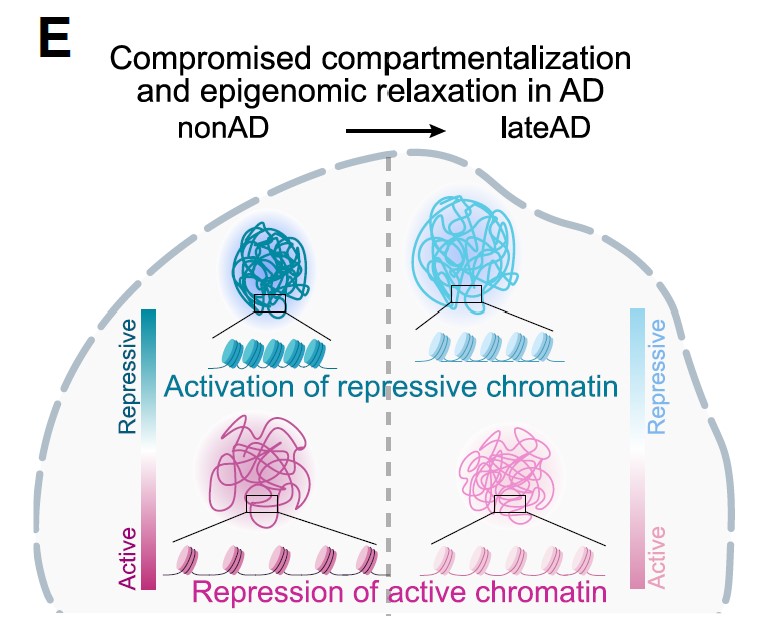
    For instance, they saw that among people who advanced to late-stage AD, normally repressive compartments opened up for more expression and compartments that were normally more open during health became more repressed. Worryingly, when the normally repressive compartments of brain cells opened up, they became more afflicted with disease.

    A schematic shows little tangles that are relatively loose or tight to demonstrate the idea that chromatin that was tight in health was loose in Alzheimer's and vice versa.
    A figure from the paper illustates a key finding of “compromised compartmentalization”: Chromatin that was locking genes down in health became more open in Alzheimer’s, while chromatin that was open became more locked down.

    “For Alzheimer’s patients, repressive compartments opened up, and gene expression levels increased, which was associated with decreased cognitive function,” explained Liu.

    But when cells managed to keep their compartments in order such that they expressed the genes they were supposed to, people remained cognitively intact.

    Meanwhile, based on the cells’ expression of their regulatory elements, the researchers created an epigenomic information score for each cell. Generally, information declined as pathology progressed but that was particularly notable among cells in the two brain regions affected earliest in Alzheimer’s: the entorhinal cortex and the hippocampus. The analyses also highlighted specific cell types that were especially vulnerable including microglia that play immune and other roles, oligodendrocytes that produce myelin insulation for neurons, and particular kinds of excitatory neurons.

    Risk genes and ‘chromatin guardians’

    Detailed analyses in the paper highlighted how epigenomic regulation tracked with disease-related problems, Liu noted. The e4 variant of the APOE gene, for instance, is widely understood to be the single biggest genetic risk factor for Alzheimer’s. In APOE4 brains, microglia initially responded to the emerging disease pathology with an increase in their epigenomic information, suggesting that they were stepping up to their unique responsibility to fight off disease. But as the disease progressed the cells exhibited a sharp drop off in information, a sign of deterioration and degeneration. This turnabout was strongest in people who had two copies of APOE4, rather than just one. The findings, Kellis said, suggest that APOE4 might destabilize the genome of microglia, causing them to burn out.

    Another example is the fate of neurons expressing the gene RELN and its protein Reelin. Prior studies, including by Kellis and Tsai, have shown that RELN- expressing neurons in the entorhinal cortex and hippocampus are especially vulnerable in Alzheimer’s, but promote resilience if they survive. The new study sheds new light on their fate by demonstrating that they exhibit early and severe epigenomic information loss as disease advances, but that in people who remained cognitively resilient the neurons maintained epigenomic information.

    In yet another example, the researchers tracked what they colloquially call “chromatin guardians” because their expression sustains and regulates cells’ epigenomic programs. For instance, cells with greater epigenomic erosion and advanced AD progression displayed increased chromatin accessibility in areas that were supposed to be locked down by Polycomb repression genes or other gene expression silencers. While resilient cells expressed genes promoting neural connectivity, epigenomically eroded cells expressed genes linked to inflammation and oxidative stress.

    “The message is clear: Alzheimer’s is not only about plaques and tangles, but about the erosion of nuclear order itself,” Kellis said. “Cognitive decline emerges when chromatin guardians lose ground to the forces of erosion, switching from resilience to vulnerability at the most fundamental level of genome regulation.

    “And when our brain cells lose their epigenomic memory marks and epigenomic information at the lowest level deep inside our neurons and microglia, it seems that Alheimer’s patients also lose their memory and cognition at the highest level.”

    Other authors of the paper are Benjamin T. James, Kyriaki Galani, Riley J. Mangan, Stuart Benjamin Fass, Chuqian Liang, Manoj M. Wagle, Carles A. Boix, Yosuke Tanigawa, Sukwon Yun, Yena Sung, Xushen Xiong, Na Sun, Lei Hou, Martin Wohlwend, Mufan Qiu, Xikun Han, Lei Xiong, Efthalia Preka, Lei Huang, William F. Li, Li-Lun Ho, Amy Grayson, Julio Mantero, Alexey Kozlenkov, Hansruedi Mathys, Tianlong Chen, Stella Dracheva, and David A. Bennett.

    Funding for the research came from The National Institutes of Health, The National Science Foundation, the Cure Alzheimer’s Fund, the Freedom Together Foundation, the Robert A. and Renee E. Belfer Family Foundation, Eduardo Eurnekian, and Joseph P. DiSabato.

    Research Article

    description
  • In Down syndrome mice, 40Hz light and sound improve cognition, neurogenesis, connectivity

    In Down syndrome mice, 40Hz light and sound improve cognition, neurogenesis, connectivity

    Study provides new evidence that sensory stimulation of gamma-frequency brain rhythms may promote broad-based restorative neurological health response.

    Studies by a growing number of labs have identified neurological health benefits from exposing human volunteers or animal models to light, sound and/or tactile stimulation at the brain’s “gamma” frequency rhythm of 40Hz. In the latest such research at The Picower Institute for Learning and Memory and Alana Down Syndrome Center at MIT, scientists found that 40Hz sensory stimulation improved cognition and circuit connectivity and encouraged the growth of new neurons in mice genetically engineered to model Down syndrome.

    Li-Huei Tsai, Picower Professor at MIT and senior author of the new study in PLOS ONE, said that the results are encouraging but also cautioned that much more work is needed to test whether the method, called GENUS (for Gamma Entrainment Using Sensory Stimulation), could provide clinical benefits for people with Down syndrome. Her lab has begun a small study with human volunteers at MIT.

    “While this work, for the first time, shows beneficial effects of GENUS on Down syndrome using an imperfect mouse model, we need to be cautious as there is not yet data showing whether this also works in humans,” said Tsai, who directs The Picower Institute and The Alana Center, and is a member of MIT’s Brain and Cognitive Sciences faculty.

    Still, she said, the newly published article adds evidence that GENUS can promote a broad-based, restorative, “homeostatic” health response in the brain amid a wide variety of pathologies. Most GENUS studies have addressed Alzheimer’s disease in humans or mice, but others have found benefits from the stimulation for conditions such as “chemo brain,” and stroke.

    Down syndrome benefits

    In the study, the research team led by postdoc Md Rezaul Islam and former graduate student Brennan Jackson worked with the commonly used “Ts65Dn” Down syndrome mouse model. The model recapitulates key aspects of the disorder, though it does not exactly mirror the human condition, which is caused by carrying an extra copy of chromosome 21.

    In the first set of experiments in the paper the team shows that an hour a day of 40Hz light and sound exposure for three weeks was associated with significant improvements on three standard short-term memory tests—two involving distinguishing novelty from familiarity and one involving spatial navigation. Because these kinds of memory tasks involve a brain region called the hippocampus, the researchers looked at neural activity there and measured a significant increase in activity indicators among mice that received the GENUS stimulation vs. those that did not.

    To better understand how stimulated mice could show improved cognition, the researchers examined whether cells in the hippocampus changed how they express their genes. To do this, the team used a technique called single cell RNA sequencing, which provided a readout of how nearly 16,000 individual neurons and other cells transcribed their DNA into RNA, a key step in gene expression. Many of the genes whose expression varied most prominently in neurons between the mice that received stimulation and those that did not were directly related to forming and organizing neural circuit connections called synapses.

    To confirm the significance of that finding, the researchers directly examined the hippocampus in stimulated and control mice. They found that in a critical subregion, the dentate gyrus, stimulated mice had significantly more synapses.

    Diving deeper

    The team not only examined gene expression across individual cells, but also analyzed that data to assess whether there were patterns of coordination across multiple genes. Indeed they found several such “modules” of co-expression. Some of this evidence further substantiated the idea that 40Hz-stimulated mice made important improvements in synaptic connectivity, but another key finding highlighted a role for TCF4, a key regulator of gene transcription needed for generating new neurons, or “neurogenesis.”

    The team’s analysis of genetic data suggested that TCF4 is underexpressed in Down syndrome mice but the researchers saw improved TCF4 expression in GENUS-stimulated mice. When the researchers went to the lab bench to determine whether the mice also exhibited a difference in neurogenesis, they found direct evidence that stimulated mice exhibited more than unstimulated mice in the dentate gyrus. These increases in TCF4 expression and neurogenesis are only correlational, the researchers noted, but they hypothesize that the increase in new neurons likely helps explain at least some of the increase in new synapses and improved short term memory function.

    “The increased putative functional synapses in the dentate gyrus is likely related to the increased adult neurogenesis observed in the Down syndrome mice following GENUS treatment,” Islam said.

    This study is the first to document that GENUS is associated with increased neurogenesis.

    The analysis of gene expression modules also yielded other key insights. One is that a cluster of genes whose expression typically declines with normal aging and in Alzheimer’s disease, remained at higher expression levels among mice who received 40Hz sensory stimulation.

    And the researchers also found evidence that mice that received stimulation retained more cells in the hippocampus that express Reelin. Reelin-expressing neurons are especially vulnerable in Alzheimer’s disease, but expression of the protein is associated with cognitive resilience amid Alzheimer’s disease pathology, which Ts65Dn mice develop. About 90 percent of people with Down syndrome develop Alzheimer’s disease, typically after the age of 40.

    “In this study, we found that GENUS enhances the percentage of Reln+ neurons in hippocampus of a mouse model of Down syndrome, suggesting that GENUS may promote cognitive resilience,” Islam said.

    Taken together with other studies, Tsai and Islam said, the new results add evidence that GENUS helps to stimulate the brain at the cellular and molecular level to mount a homeostatic response to aberrations caused by disease pathology, be it neurodegeneration in Alzheimer’s, demyelination in chemo brain, or deficits of neurogenesis in Down syndrome.

    But the authors also cautioned that the study had limits. Not only is the Ts65Dn model an imperfect reflection of human Down syndrome, but also the mice used were all male. Moreover, the cognitive tests in the study only measured short-term memory. And finally, while the study was novel for extensively examining gene expression in the hippocampus amid GENUS stimulation, it did not look at changes in other cognitively critical brain regions such as the prefrontal cortex.

    In addition to Jackson, Islam and Tsai, the paper’s other authors are Maeesha Tasnim Naomi, Brooke Schatz, Noah Tan, Mitchell Murdock, Dong Shin Park, Daniela Rodrigues Amorim, Fred Jiang, S. Sebastian Pineda, Chinnakkaruppan Adaikkan, Vanesa Fernandez, Ute Geigenmuller, Rosalind Mott Firenze, Manolis Kellis and Ed Boyden.

    Funding for the study came from the Alana Down Syndrome Center at MIT and the Alana USA Foundation, the National Science Foundation, the “la Caixa” Banking Foundation, an EMBO long term postdoctoral fellowship, Barbara J. Weedon, Henry E. Singleton, and the Hubolow family.

    description
  • Review: Evidence expanding that 40Hz gamma stimulation promotes brain health

    Review: Evidence expanding that 40Hz gamma stimulation promotes brain health

    A decade of studies from labs around the world provide a growing evidence base that increasing the power of the brain’s gamma rhythms could help fight Alzheimer’s, and perhaps other, neurological diseases.

    A decade after scientists in The Picower Institute for Learning and Memory at MIT first began testing whether sensory stimulation of the brain’s 40Hz “gamma” frequency rhythms could treat Alzheimer’s disease in mice, a growing evidence base supporting the idea that it can improve brain health—in humans as well as animals—has emerged from the work of labs all over the world. A new review article in PLOS Biology describes the state of research so far and presents some of the fundamental and clinical questions at the forefront of the non-invasive gamma stimulation now.

    “As we’ve made all our observations, many other people in the field have published results that are very consistent,” said Li-Huei Tsai, Picower Professor at MIT, director of MIT’s Aging Brain Initiative, and senior author of the new review with postdoc Jung Park. “People have used many different ways to induce gamma including sensory stimulation, transcranial alternating current stimulation or transcranial magnetic stimulation, but the key is delivering stimulation at 40 Hz. They all see beneficial effects.”

    A decade of discovery at MIT

    Starting with a paper in Nature in 2016, a collaboration led by Tsai has produced a series of studies showing that 40Hz stimulation via light, sound, the two combined, or tactile vibration reduces hallmarks of Alzheimer’s pathology such as amyloid and tau proteins, prevents neuron death, decreases synapse loss, and sustains memory and cognition in various Alzheimer’s mouse models. The collaboration’s investigations of the underlying mechanisms that produce these benefits has so far identified specific cellular and molecular responses in many brain cell types including neurons, microglia, astrocytes, oligodendrocytes and the brain’s blood vessels. Last year, for instance, the lab reported in Nature that 40Hz audio and visual stimulation induced interneurons in mice to increase release of the peptide VIP, prompting increased clearance of amyloid from brain tissue via the brain’s glymphatic “plumbing” system.

    Meanwhile, at MIT and at the MIT spinoff company Cognito Therapeutics, phase II clinical studies have shown that people with Alzheimer’s exposed to 40Hz light and sound experienced a significant slowing of brain atrophy and improvements on some cognitive measures compared to untreated controls. Cognito, which has also measured significant preservation of the brain’s “white matter” in volunteers, has been conducting a pivotal, nationwide phase III clinical trial of sensory gamma stimulation for more than a year.

    “Neuroscientists often lament that it is a great time to have AD if you are a mouse,” Park and Tsai wrote in the review. “Our ultimate goal, therefore, is to translate GENUS discoveries into a safe, accessible, and non-invasive therapy for AD patients.” The MIT team often refers to 40Hz stimulation as “GENUS” for Gamma Entrainment Using Sensory Stimulation.

    A growing field

    As Tsai’s collaboration, which includes MIT colleagues Edward Boyden and Emery N. Brown, has published its results, many other labs have produced studies adding to the evidence that various methods of non-invasive gamma sensory stimulation can combat Alzheimer’s pathology. Among many examples cited in the new review, in 2024 a research team in China independently corroborated that 40Hz sensory stimulation increases glymphatic fluid flows in mice. In another example, a Harvard Medical School-based team in 2022 showed that 40Hz gamma stimulation using Transcranial Alternating Current Stimulation significantly reduced the burden of tau in three out of four human volunteers. And in another study involving more than 100 people, researchers in Scotland in 2023 used audio and visual gamma stimulation (at 37.5 Hz) to improve memory recall.

    Open questions

    Amid the growing number of publications describing preclinical studies with mice and clinical trials with people, open questions remain, Tsai and Park acknowledge. The MIT team and others are still exploring the cellular and molecular mechanisms that underlie GENUS’s effects. Tsai said her lab is looking at other neuropeptide and neuromodulatory systems to better understand the cascade of events linking sensory stimulation to the observed cellular responses. Meanwhile the nature of how some cells, such as microglia, respond to gamma stimulation and how that affects pathology remains unclear, Tsai added.

    Even with a national Phase III clinical trial underway, it is still important to investigate these fundamental mechanisms, Tsai said, because new insights into how non-invasive gamma stimulation affects the brain could improve and expand its therapeutic potential.

    “The more we understand the mechanisms, the more we will have good ideas about how to further optimize the treatment,” Tsai said. “And the more we understand its action and the circuits it affects, the more we will know beyond Alzheimer’s disease what other neurological disorders will benefit from this.”

    Indeed the review points to studies at MIT and other institutions providing at least some evidence that GENUS might be able to help with Parkinson’s disease, stroke, anxiety, epilepsy, and the cognitive side effects of chemotherapy and conditions that reduce myelin such as multiple sclerosis. Tsai’s lab has been studying whether it can help with Down syndrome as well.

    The open questions may help define the next decade of GENUS research.

    description
  • Study reveals ways in which 40Hz sensory stimulation may preserve brain’s ‘white matter’

    Study reveals ways in which 40Hz sensory stimulation may preserve brain’s ‘white matter’

    MIT scientists report that gamma frequency light and sound stimulation preserves myelination in mouse models and reveal molecular mechanisms that may underlie the benefit.

    Early-stage trials in Alzheimer’s disease patients and studies in mouse models of the disease have suggested positive impacts on pathology and symptoms from exposure to light and sound presented at the “gamma” band frequency of 40 Hz. A new study zeroes in on how 40Hz sensory stimulation helps to sustain an essential process in which the signal-sending branches of neurons, called axons, are wrapped in a fatty insulation called myelin. Often called the brain’s “white matter,” myelin protects axons and insures better electrical signal transmission in brain circuits.

    “Previous publications from our lab have mainly focused on neuronal protection,” said Li-Huei Tsai, Picower Professor in The Picower Institute for Learning and Memory and the Department of Brain and Cognitive Sciences at MIT and senior author of the new study in Nature Communications. Tsai also lead’s MIT’s Aging Brain Initiative. “But this study shows that it’s not just the gray matter, but also the white matter that’s protected by this method.”

    This year Cognito Therapeutics, the spin-off company that licensed MIT’s sensory stimulation technology, published phase II human trial results in the Journal of Alzheimer’s Disease indicating that 40Hz light and sound stimulation significantly slowed the loss of myelin in volunteers with Alzheimer’s. Also this year Tsai’s lab published a study showing that gamma sensory stimulation helped mice withstand neurological effects of chemotherapy medicines, including by preserving myelin. In the new study, members of Tsai’s lab led by former postdoc Daniela Rodrigues Amorim used a common mouse model of myelin loss—a diet with the chemical cuprizone— to explore how sensory stimulation preserves myelination.

    Amorim and Tsai’s team found that 40Hz light and sound not only preserved myelination in the brains of cuprizone-exposed mice, it also appeared to protect oligodendrocytes (the cells that myelinate neural axons), sustain the electrical performance of neurons, and preserve a key marker of axon structural integrity. When the team looked into the molecular underpinnings of these benefits, they found clear signs of specific mechanisms including preservation of neural circuit connections called synapses; a reduction in a cause of oligodendrocyte death called “ferroptosis;” reduced inflammation; and an increase in the ability of microglia brain cells to clean up myelin damage so that new myelin could be restored.

    “Gamma stimulation promotes a healthy environment,” said Amorim who is now a Marie Curie Fellow at the University of Galway in Ireland. “There are several ways we are seeing different effects.”

    The findings suggest that gamma sensory stimulation may help not only Alzheimer’s disease patients but also people battling other diseases involving myelin loss, such as multiple sclerosis, the authors wrote in the study.

    Maintaining myelin

    To conduct the study, Tsai and Amorim’s team fed some male mice a diet with cuprizone and gave other male mice a normal diet for six weeks. Halfway into that period, when cuprizone is known to begin causing its most acute effects on myelination, they exposed some mice from each group to gamma sensory stimulation for the remaining three weeks. In this way they had four groups: completely unaffected mice, mice that received no cuprizone but did get gamma stimulation, mice that received cuprizone and constant (but not 40Hz) light and sound as a control, and mice that received cuprizone and also gamma stimulation.

    After the six weeks elapsed, the scientists measured signs of myelination throughout the brains of the mice in each group. Mice that weren’t fed cuprizone maintained healthy levels, as expected. Mice that were fed cuprizone and didn’t receive 40Hz gamma sensory stimulation showed drastic levels of myelin loss. Cuprizone-fed mice that received 40Hz stimulation retained significantly more myelin, rivaling the health of mice never fed cuprizone by some, but not all, measures.

    The researchers also looked at numbers of oligodendrocytes to see if they survived better with sensory stimulation. Several measures revealed that in mice fed cuprizone, oligodendrocytes in the corpus callosum region of the brain (a key point for the transit of neural signals because it connects the brain’s hemispheres) were markedly reduced. But in mice fed cuprizone and also treated with gamma stimulation, the number of cells were much closer to healthy levels.

    Electrophysiological tests among neural axons in the corpus callosum showed that gamma sensory stimulation was associated with improved electrical performance in cuprizone-fed mice who received gamma stimulation compared to cuprizone-fed mice left untreated by 40Hz stimulation. And when researchers looked in the anterior cingulate cortex region of the brain, they saw that MAP2, a protein that signals the structural integrity of axons, was much better preserved in mice that received cuprizone and gamma stimulation compared to cuprizone-fed mice who did not.

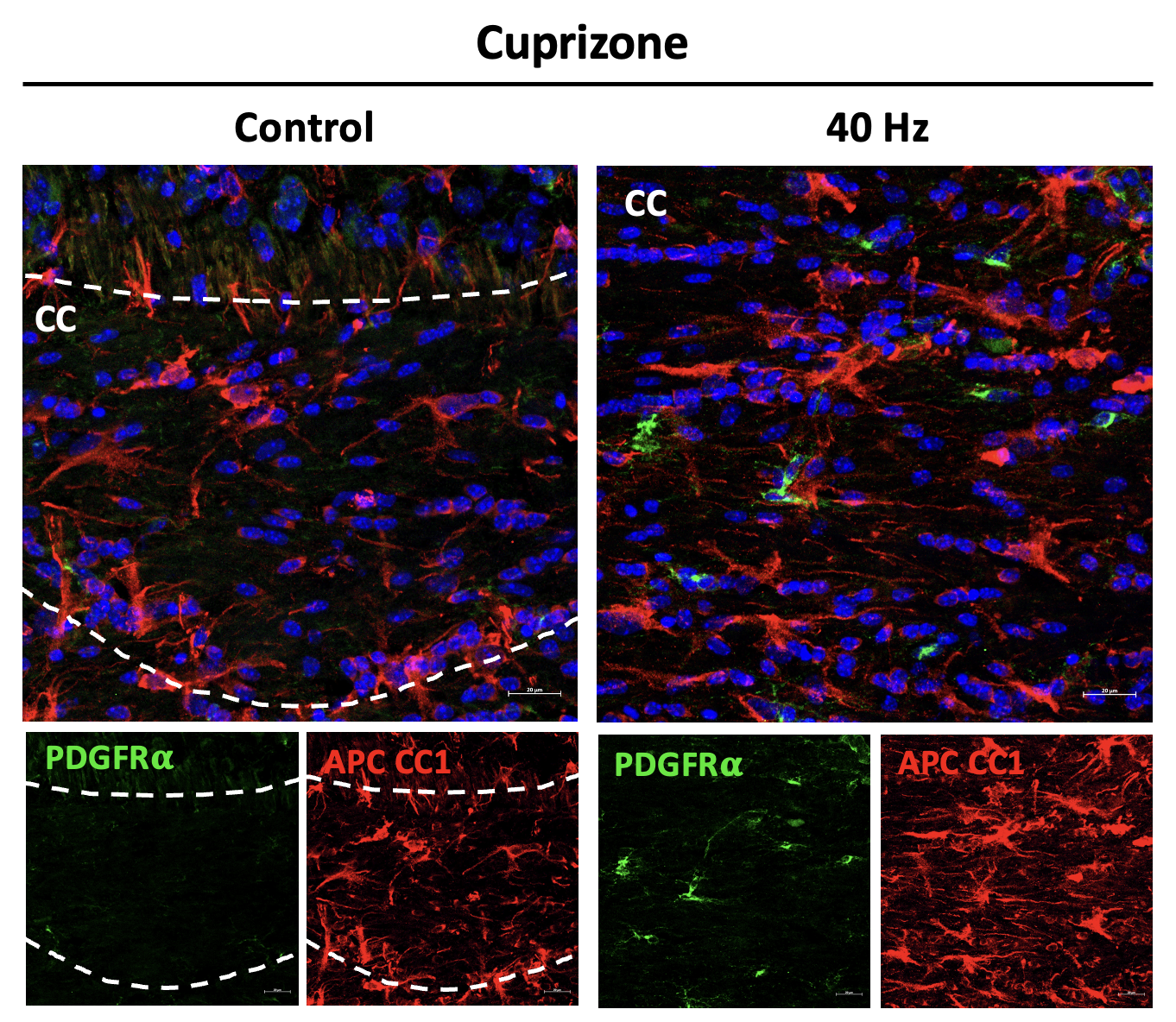
    Side by side panels labeled cuprizone control and cuprizone 40hz compare amounts of cells stained red and green. The 40Hz panel shows much more red and green staining.
    To assess the number of immature and mature oligodendrocytes in the corpus callosum in mice fed cuprizone and given 40 Hz stimulation (right), compared to mice fed cuprizone and given constant stimulation as a control, researchers measured the marker PDGFRa (green) and APCCC1 (red). The 40Hz group exhibited a signficantly higher number of each type of oligodendrocytes.

    Molecular mechanisms

    A key goal of the study was to identify possible ways in which 40Hz sensory stimulation may protect myelin.

    To find out, the researchers conducted a sweeping assessment of protein expression in each mouse group and identified which proteins were differentially expressed based on cuprizone diet and exposure to gamma frequency stimulation. The analysis revealed distinct sets of effects between the cuprizone mice exposed to control stimulation and cuprizone-plus-gamma mice.

    A highlight of one set of effects was the increase in MAP2 in gamma-treated cuprizone-fed mice. A highlight of another set was that cuprizone mice who received control stimulation showed a substantial deficit in expression of proteins associated with synapses. The gamma-treated cuprizone-fed mice did not show any significant loss, mirroring results in a 2019 Alzheimer’s 40Hz study that showed synaptic preservation. This result is important, the researchers wrote, because neural circuit activity, which depends on maintaining synapses, is associated with preserving myelin. They confirmed the protein expression results by looking directly at brain tissues.

    Another set of protein expression results hinted at another important mechanism: ferroptosis. This phenomenon, in which errant metabolism of iron leads to a lethal buildup of reactive oxygen species in cells, is a known problem for oligodendrocytes in the cuprizone mouse model. Among the signs was an increase in cuprizone-fed, control stimulation mice in expression of the protein HMGB1, which is a marker of ferroptosis-associated damage that triggers an inflammatory response. Gamma stimulation, however, reduced levels of HMGB1.

    Looking more deeply at the cellular and molecular response to cuprizone demyelination and the effects of gamma stimulation, the team assessed gene expression using single-cell RNA sequencing technology. They found that astrocytes and microglia became very inflammatory in cuprizone-control mice but gamma stimulation calmed that response. Fewer cells became inflammatory and direct observations of tissue showed that microglia became more proficient at clearing away myelin debris, a key step in effecting repairs.

    The team also learned more about how oligodendrocytes in cuprizone-fed mice exposed to 40Hz sensory stimulation managed to survive better. Expression of protective proteins such as HSP70 increased and as did expression of GPX4, a master regulator of processes that constrain ferroptosis.

    In addition to Amorim and Tsai, the paper’s other authors are Lorenzo Bozzelli, TaeHyun Kim, Liwang Liu, Oliver Gibson, Cheng-Yi Yang, Mitch Murdock, Fabiola Galiana-Meléndez, Brooke Schatz, Alexis Davison, Md Rezaul Islam, Dong Shin Park, Ravikiran M. Raju, Fatema Abdurrob, Alissa J. Nelson, Jian Min Ren, Vicky Yang and Matthew P. Stokes.

    Fundacion Bancaria la Caixa, The JPB Foundation, The Picower Institute for Learning and Memory, the Carol and Gene Ludwig Family Foundation, Lester A. Gimpelson, Eduardo Eurnekian, The Dolby Family, Kathy and Miguel Octavio, the Marc Haas Foundation, Ben Lenail and Laurie Yoler, and the National Institutes of Health provided funding for the study.

    description
  • Study across multiple brain regions discerns Alzheimer’s vulnerability and resilience factors

    Study across multiple brain regions discerns Alzheimer’s vulnerability and resilience factors

    Genomics and lab studies reveal numerous findings, including a key role for Reelin amid neuronal vulnerability, and for choline and antioxidants in sustaining cognition

    An MIT study published today in Nature provides new evidence for how specific cells and circuits become vulnerable in Alzheimer’s disease, and hones in on other factors that may help some people show resilience to cognitive decline, even amid clear signs of disease pathology. To highlight potential targets for interventions to sustain cognition and memory, the authors engaged in a novel comparison of gene expression across multiple brain regions in people with or without Alzheimer’s disease, and conducted lab experiments to test and validate their major findings.

    Brain cells all have the same DNA but what makes them differ, both in their identity and their activity, are their patterns of how they express those genes. The new analysis measured gene expression differences in more than 1.3 million cells of more than 70 cell types in six brain regions from 48 tissue donors, 26 of whom died with an Alzheimer’s diagnosis and 22 of whom without. As such, the study provides a uniquely large, far-ranging and yet detailed accounting of how brain cell activity differs amid Alzheimer’s disease by cell type, by brain region, by disease pathology, and by each person’s cognitive assessment while still alive.

    “Specific brain regions are vulnerable in Alzheimer’s and there is an important need to understand how these regions or particular cell types are vulnerable,” said co-senior author Li-Huei Tsai, Picower Professor of Neuroscience and director of The Picower Institute for Learning and Memory and the Aging Brain Initiative at MIT. “And the brain is not just neurons. It’s many other cell types. How these cell types may respond differently, depending on where they are, is something fascinating we are only at the beginning of looking at.”

    Co-senior author Manolis Kellis, professor of computer science and head of MIT’s Computational Biology Group, likened the technique used to measure gene expression comparisons, single cell RNA profiling, to being a much more advanced “microscope” than the ones that first allowed Alois Alzheimer to characterize the disease’s pathology more than a century ago.

    “Where Alzheimer saw amyloid protein plaques and phosphorylated tau tangles in his microscope, our single-cell ‘microscope’ tells us, cell by cell and gene by gene, about thousands of subtle yet important biological changes in response to pathology,” said Kellis. “Connecting this information with the cognitive state of patients reveals how cellular responses relate with cognitive loss or resilience, and can help propose new ways to treat cognitive loss. Pathology can precede cognitive symptoms by a decade or two before cognitive decline becomes diagnosed. If there’s not much we can do about the pathology at that stage, we can at least try to safeguard the cellular pathways that maintain cognitive function.”

    Hansruedi Mathys, a former MIT postdoc in the Tsai Lab, who is now an assistant professor at the University of Pittsburgh, Carles Boix, a former graduate student in Kellis’s lab who is now a postdoc at Harvard Medical School, and Leyla Akay, a graduate student in Tsai’s lab, led the study analyzing the prefrontal cortex, entorhinal cortex, hippocampus, anterior thalamus, angular gyrus, and the midtemporal cortex. The brain samples came from the Religious Order Study and the Rush Memory and Aging Project at Rush University.

    Neural vulnerability and Reelin

    Some of the earliest signs of amyloid pathology and neuron loss in Alzheimer’s occurs in memory-focused regions called the hippocampus and the entorhinal cortex. In those regions, and in other parts of the cerebral cortex, the researchers were able to pinpoint a potential reason why. One type of excitatory neuron in the hippocampus and four in the entorhinal cortex were significantly less abundant in people with Alzheimer’s than in people without. Individuals with depletion of those cells performed significantly worse on cognitive assessments. Moreover, many vulnerable neurons were interconnected in a common neuronal circuit. And just as importantly, several either directly expressed a protein called Reelin, or were directly affected by Reelin signaling. In all, therefore, the findings distinctly highlight especially vulnerable neurons, whose loss is associated with reduced cognition, that share a neuronal circuit and a molecular pathway.

    Tsai noted that Reelin has become prominent in Alzheimer’s research because of a recent study of a man in Colombia. He had a rare mutation in the Reelin gene that caused the protein to be more active, and was able to stay cognitively healthy at an advanced age despite having a strong family predisposition to early-onset Alzheimer’s. The new study shows that loss of Reelin-producing neurons is associated with cognitive decline. Taken together it may mean that the brain benefits from Reelin, but that neurons that produce it may be lost in at least some Alzheimer’s patients.

    “We can think of Reelin as having maybe some kind of protective or beneficial effect,” Akay said. “But we don’t yet know what it does or how it could confer resilience.”

    In further analysis the researchers also found that specifically vulnerable inhibitory neuron subtypes identified in a previously study from this group in the prefrontal cortex also were involved in reelin signaling, further reinforcing the significance of the molecule and its signaling pathway.

    To further check their results, the team directly examined the human brain tissue samples and the brains of two kinds of Alzheimer’s model mice. Sure enough, those experiments also showed a reduction in Reelin-positive neurons in the human and mouse entorhinal cortex.

    Resilience associated with choline metabolism in astrocytes

    To find factors that might preserve cognition, even amid pathology, the team examined which genes, in which cells, and in which regions, were most closely associated with cognitive resilience, which they defined as residual cognitive function, above the typical cognitive loss expected given the observed pathology.

    Their analysis yielded a surprising and specific answer: across several brain regions astrocytes that expressed genes associated with antioxidant activity and with choline metabolism and polyamine biosynthesis were significantly associated with sustained cognition, even amid high levels of tau and amyloid. The results reinforced previous research findings led by Tsai and Susan Lundqvist in which they showed that dietary supplement of choline helped astrocytes cope with the dysregulation of lipids caused by the most significant Alzheimer’s risk gene, the APOE4 variant. The antioxidant findings also pointed to a molecule that can be found as a dietary supplement, spermidine, which may have anti-inflammatory properties, although such an association would need further work to be established causally.

    As before, the team went beyond the predictions from the single-cell RNA expression analysis to make direct observations in the brain tissue of samples. Those that came from cognitively resilient individuals indeed showed increased expression of several of the astrocyte-expressed genes predicted to be associated with cognitive resilience.

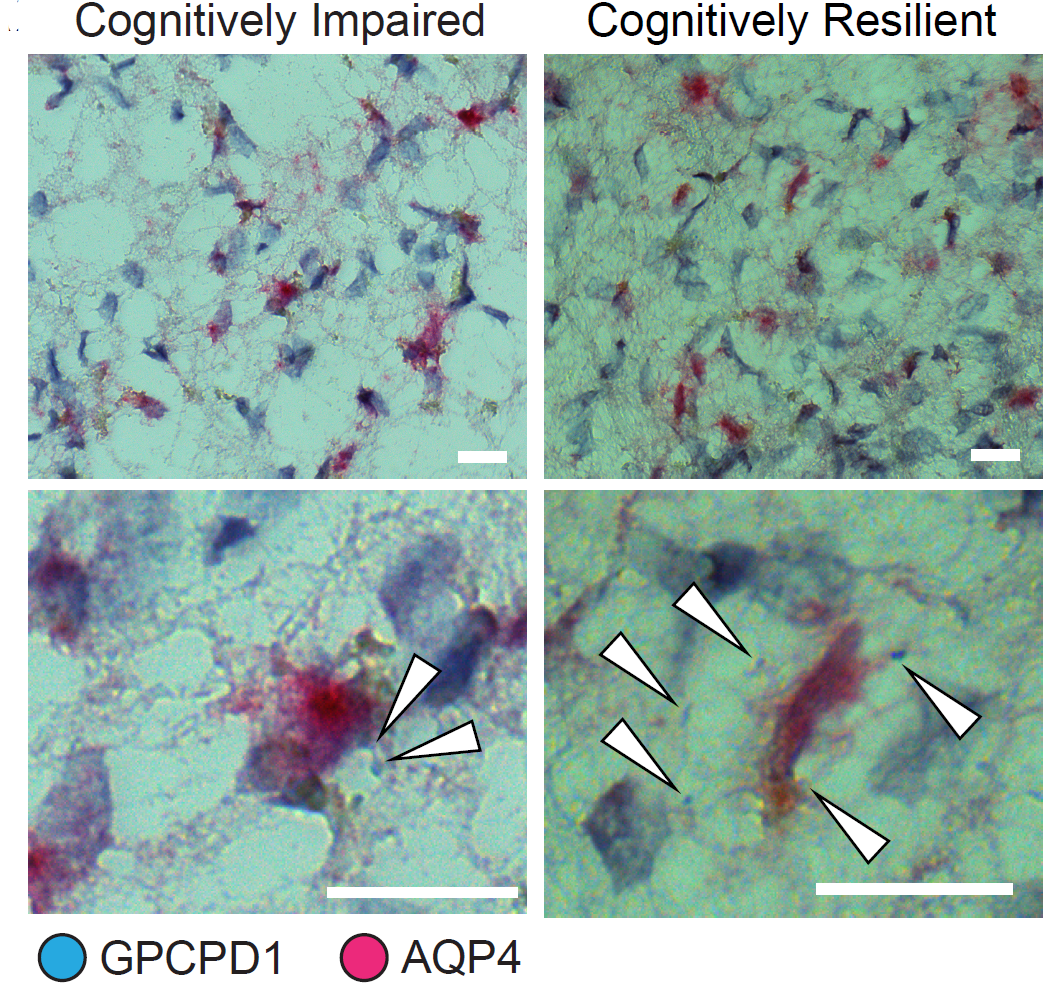
    In two columns labeled "Cognitively Impaired" and "Cognitively Resistent" microscope images show astrocyte cells with magenta staining. Small blue dots are visible around some of the astrocyte cells and those dots are indicated by large white arrows.
    Expression of the gene GPCPD1 in astrocyte cells is associated with cognitive resilience in people with Alzheimer’s pathology. Here white arrows indicate instances of GPCPD1 expression (blue) in astrocyte cells (denoted by AQP4 staining in magenta). There is much more expression in tissue from the cognitively resilient person (right).

    New analysis method, open dataset

    To analyze the mountains of single-cell data, the researchers developed a new robust methodology based on groups of coordinately-expressed genes (known as “gene modules”), thus exploiting the expression correlation patterns between functionally-related genes in the same module.

    “In principle, the 1.3 million cells we surveyed could use their 20,000 genes in an astronomical number of different combinations,” explain Kellis. “In practice, however, we observe a much smaller subset of coordinated changes. Recognizing these coordinated patterns allow us to infer much more robust changes, because they are based on multiple genes in the same functionally-connected module.”

    He offered this analogy: With many joints in their bodies, people could move in all kinds of crazy ways, but in practice they engage in many fewer coordinated movements like walking, running, or dancing. The new method enables scientists to identify such coordinated gene expression programs as a group.

    While Kellis and Tsai’s labs already reported several noteworthy findings from the dataset, the researchers expect that many more possibly significant discoveries still wait to be found in the trove of data. To facilitate such discovery the team posted handy analytical and visualization tools along with the data on Kellis’s website at: https://compbio.mit.edu/ad_multiregion.

    “The dataset is so immensely rich. We focused on only a few aspects that are salient that we believe are very, very interesting, but by no means have we exhausted what can be learned with this dataset,” Kellis said. “We expect many more discoveries ahead, and we hope that young researchers (of all ages) will dive right in and surprise us with many more insights.”

    Going forward, Kellis said, the researchers are studying the control circuitry associated with the differentially expressed genes, to understand the genetic variants, the regulators, and other driver factors that can be modulated to reverse disease circuitry across brain regions, cell types, and different stages of the disease.

    Additional authors of the study include Ziting Xia, Jose Davila Velderrain, Ayesha P. Ng, Xueqiao Jiang, Ghada Abdelhady, Kyriaki Galani, Julio Mantero, Neil Band, Benjamin T. James, Sudhagar Babu, Fabiola Galiana-Melendez, Kate Louderback, Dmitry Prokopenko, Rudolph E. Tanzi, and David A. Bennett.

    Support for the research came from the National Institutes of Health, The Picower Institute for Learning and Memory, The JPB Foundation, the Cure Alzheimer’s Fund, The Robert A. and Renee E. Belfer Family Foundation, Eduardo Eurnekian, and Joseph DiSabato.

    description
  • Congratulations Mingus Rae Zoller

    Congratulations Mingus Rae Zoller

    Graduate student Mingus Rae Zoller has been named to the Howard Hughes Medical Institute’s highly selective Gilliam Fellows Program.

    Read the full story on The Picower Institute website: https://picower.mit.edu/news/fellowship-supports-students-work-advance-alzheimers-research-and-equity

    description
  • A noninvasive treatment for “chemo brain”

    A noninvasive treatment for “chemo brain”

    Stimulating gamma brain waves may protect cancer patients from memory impairment and other cognitive effects of chemotherapy.

    Patients undergoing chemotherapy often experience cognitive effects such as memory impairment and difficulty concentrating — a condition commonly known as “chemo brain.”

    MIT researchers have now shown that a noninvasive treatment that stimulates gamma frequency brain waves may hold promise for treating chemo brain. In a study of mice, they found that daily exposure to light and sound with a frequency of 40 hertz protected brain cells from chemotherapy-induced damage. The treatment also helped to prevent memory loss and impairment of other cognitive functions.

    This treatment, which was originally developed as a way to treat Alzheimer’s disease, appears to have widespread effects that could help with a variety of neurological disorders, the researchers say.

    “The treatment can reduce DNA damage, reduce inflammation, and increase the number of oligodendrocytes, which are the cells that produce myelin surrounding the axons,” says Li-Huei Tsai, director of MIT’s Picower Institute for Learning and Memory and Picower Professor in the MIT Department of Brain and Cognitive Sciences. “We also found that this treatment improved learning and memory, and enhanced executive function in the animals.”

    Tsai, who also leads MIT’s Aging Brain Initiative, is the senior author of the new study, which appears today in Science Translational Medicine. The paper’s lead author is TaeHyun Kim, an MIT postdoc.

    Protective brain waves

    Several years ago, Tsai and her colleagues began exploring the use of light flickering at 40 hertz (cycles per second) as a way to improve the cognitive symptoms of Alzheimer’s disease. Previous work had suggested that Alzheimer’s patients have impaired gamma oscillations — brain waves that range from 25 to 80 hertz (cycles per second) and are believed to contribute to brain functions such as attention, perception, and memory.

    Tsai’s studies in mice have found that exposure to light flickering at 40 hertz or sounds with a pitch of 40 hertz can stimulate gamma waves in the brain, which has many protective effects, including preventing the formation of amyloid beta plaques. Using light and sound together provides even more significant protection. The treatment also appears promising in humans: Phase 1 clinical trials in people with early-stage Alzheimer’s disease have found the treatment is safe and does offer some neurological and behavioral benefits.

    In the new study, the researchers set out to see whether this treatment could also counteract the cognitive effects of chemotherapy treatment. Research has shown that these drugs can induce inflammation in the brain, as well as other detrimental effects such as loss of white matter — the networks of nerve fibers that help different parts of the brain communicate with each other. Chemotherapy drugs also promote loss of myelin, the protective fatty coating that allows neurons to propagate electrical signals. Many of these effects are also seen in the brains of people with Alzheimer’s.

    “Chemo brain caught our attention because it is extremely common, and there is quite a lot of research on what the brain is like following chemotherapy treatment,” Tsai says. “From our previous work, we know that this gamma sensory stimulation has anti-inflammatory effects, so we decided to use the chemo brain model to test whether sensory gamma stimulation can be beneficial.”

    On a black background two panels show spiny microglia cells. In the left panel many are bright red but in the right panel there is very little red coloration
    Red staining denotes microglia brain cells bearing the microglia marker Iba1 and the green staining microglia inflammatory marker CD68. In mice exposed to cisplatin and left untreated by 40Hz stimulation (left), a lot of red and green staining is evident. In cisplatin-exposed mice who received 40Hz treatment (right) the red and green staining (and inflammation) is reduced.

    As an experimental model, the researchers used mice that were given cisplatin, a chemotherapy drug often used to treat testicular, ovarian, and other cancers. The mice were given cisplatin for five days, then taken off of it for five days, then on again for five days. One group received chemotherapy only, while another group was also given 40-hertz light and sound therapy every day.

    After three weeks, mice that received cisplatin but not gamma therapy showed many of the expected effects of chemotherapy: brain volume shrinkage, DNA damage, demyelination, and inflammation. These mice also had reduced populations of oligodendrocytes, the brain cells responsible for producing myelin.

    However, mice that received gamma therapy along with cisplatin treatment showed significant reductions in all of those symptoms. The gamma therapy also had beneficial effects on behavior: Mice that received the therapy performed much better on tests designed to measure memory and executive function.

    “A fundamental mechanism”

    Using single-cell RNA sequencing, the researchers analyzed the gene expression changes that occurred in mice that received the gamma treatment. They found that in those mice, inflammation-linked genes and genes that trigger cell death were suppressed, especially in oligodendrocytes, the cells responsible for producing myelin.

    In mice that received gamma treatment along with cisplatin, some of the beneficial effects could still be seen up to four months later. However, the gamma treatment was much less effective if it was started three months after the chemotherapy ended.

    The researchers also showed that the gamma treatment improved the signs of chemo brain in mice that received a different chemotherapy drug, methotrexate, which is used to treat breast, lung, and other types of cancer.

    “I think this is a very fundamental mechanism to improve myelination and to promote the integrity of oligodendrocytes. It seems that it’s not specific to the agent that induces demyelination, be it chemotherapy or another source of demyelination,” Tsai says.

    Because of its widespread effects, Tsai’s lab is also testing gamma treatment in mouse models of other neurological diseases, including Parkinson’s disease and multiple sclerosis. Cognito Therapeutics, a company founded by Tsai and MIT Professor Edward Boyden, has finished a phase 2 trial of gamma therapy in Alzheimer’s patients, and plans to begin a phase 3 trial this year.

    “My lab’s major focus now, in terms of clinical application, is Alzheimer’s; but hopefully we can test this approach for a few other indications, too,” Tsai says.

    The research was funded by the JPB Foundation, the Ko Hahn Seed Fund, and the National Institutes of Health.

    –From MIT News

    description